Externalizing Access Control
In business application development, authorization management is often an afterthought. Yet it forms a fundamental pillar of security and compliance. This article explores the benefits of externalizing access control through a concrete case study: a hospital patient records management application.
Scattered and Hard-to-Maintain Authorizations
Authorization Spaghetti Code
In a traditional approach, authorization rules are scattered throughout the application code:
// Typical example of "hardcoded" authorization logic
public Patient getPatient(Long id, User user) {
    Patient patient = patientRepository.findById(id);

    if (user.hasRole("ADMIN")) {
        return patient;
    }

    if (user.getDepartment().equals(patient.getDepartment())) {
        if (user.hasRole("PHYSICIAN") || user.hasRole("NURSE")) {
            return patient;
        }
    }

    if (patient.getCareTeam().contains(user.getId())) {
        return patient;
    }

    throw new AccessDeniedException("Access denied");
}
This code presents several issues:
- Tight coupling: business logic and access rules are mixed together
- Duplication: these checks are repeated throughout the application
- Rigidity: any modification requires redeployment
- Opacity: impossible to answer “who can access what?”
Healthcare Industry Challenges
In the hospital domain, requirements are particularly stringent:
- Regulatory compliance (GDPR, HIPAA, HITECH)
- Audit trail for sensitive data access
- Fine-grained permissions based on roles and context
- Emergency procedures (“break-glass”)
The Solution: Externalization with Big ACL
Externalized Architecture
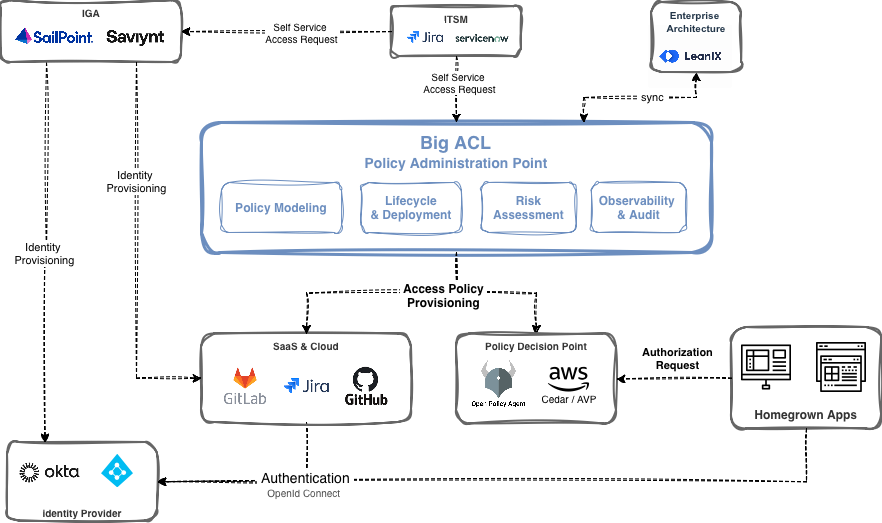
Access control externalization relies on the PDP/PEP pattern (Policy Decision Point / Policy Enforcement Point):
┌─────────────────┐     ┌─────────────────┐     ┌─────────────────┐
│   Application   │────▶│   PEP (SDK)     │────▶│   PDP (OPA)     │
│   Hospital      │     │   Big ACL       │     │   Policies      │
└─────────────────┘     └─────────────────┘     └─────────────────┘
                                                        │
                                                        ▼
                                               ┌─────────────────┐
                                               │   PAP (Console) │
                                               │   Big ACL       │
                                               └─────────────────┘
- PEP (Policy Enforcement Point): intercepts requests and enforces decisions
- PDP (Policy Decision Point): evaluates rules and makes decisions
- PAP (Policy Administration Point): policy management interface
Demonstration: The Hospital Demo Application
Our demo application simulates a hospital patient portal with sophisticated access rules: department-based access, role-based permissions, care team membership, and emergency “break-glass” procedures.
Access Control in Action
Depending on the user’s profile, permissions vary automatically. An ER physician only sees patients from their department, while a department head has broader access.
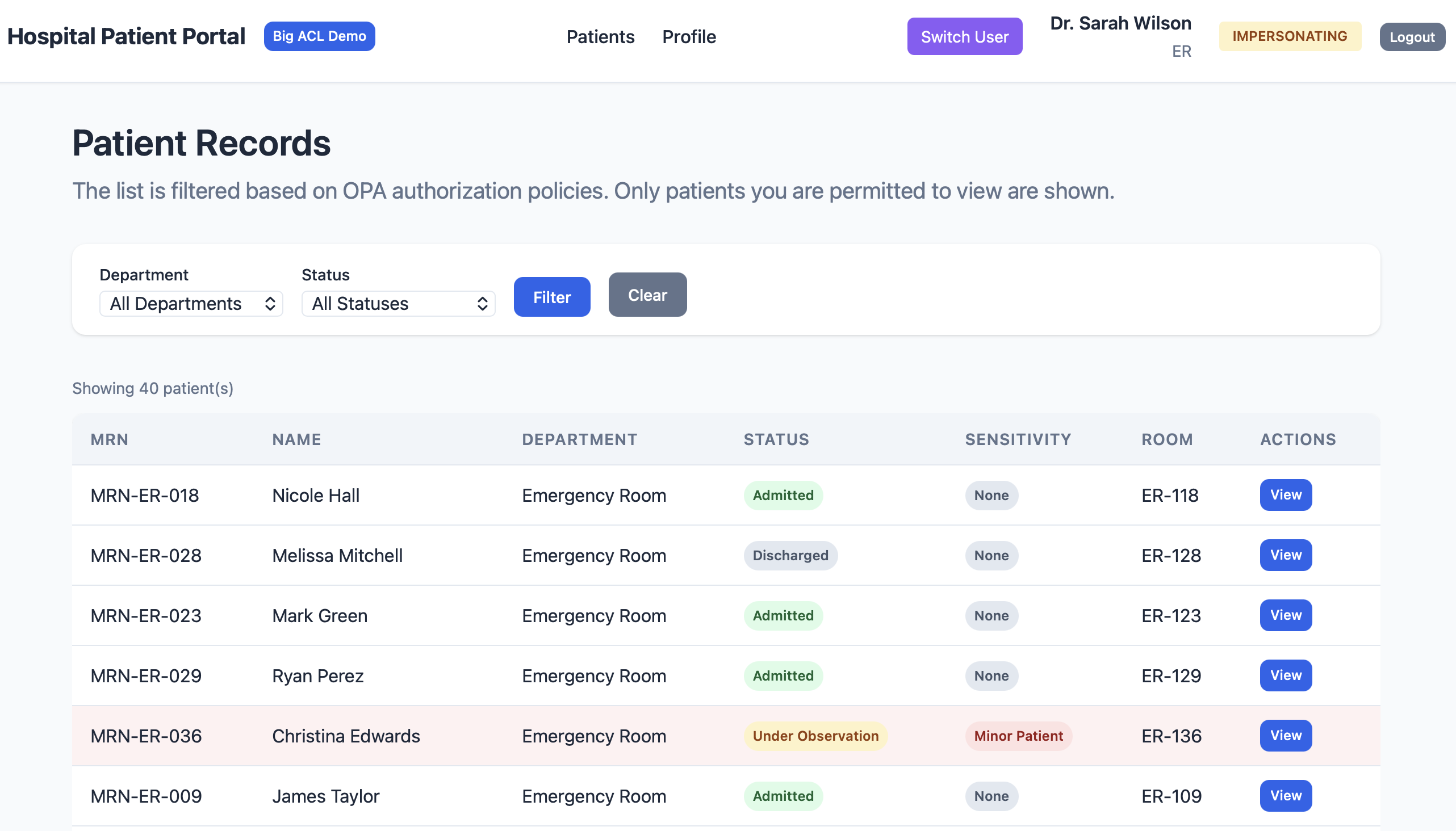 [Screenshot: Access comparison between a physician and a nurse on the same patient record - showing available/unavailable actions based on profile]
Policies in Rego
A Declarative and Expressive Language
Authorization rules are defined in Rego, Open Policy Agent’s policy language:
package hospital.authz

# Main authorization rule
allow {
    input.action == "view"
    is_care_team_member
}

allow {
    input.action == "view"
    same_department
    is_clinical_staff
}

# A care team member can always access
is_care_team_member {
    input.subject.id == input.resource.careTeamUserIds[_]
}

# Department check
same_department {
    input.subject.department == input.resource.department
}

# Clinical staff
is_clinical_staff {
    input.subject.roles[_] == "ROLE_PHYSICIAN"
}

is_clinical_staff {
    input.subject.roles[_] == "ROLE_NURSE"
}
Benefits of Declarative Policies
- Readability: rules are understandable by non-developers
- Testability: policies can be unit tested
- Auditability: complete history of changes
- Reusability: same policies for multiple applications
Administration with Big ACL PAP
Centralized Management Console
The Big ACL PAP offers an intuitive interface for managing policies: real-time editing, simulation before deployment, and complete decision traceability.
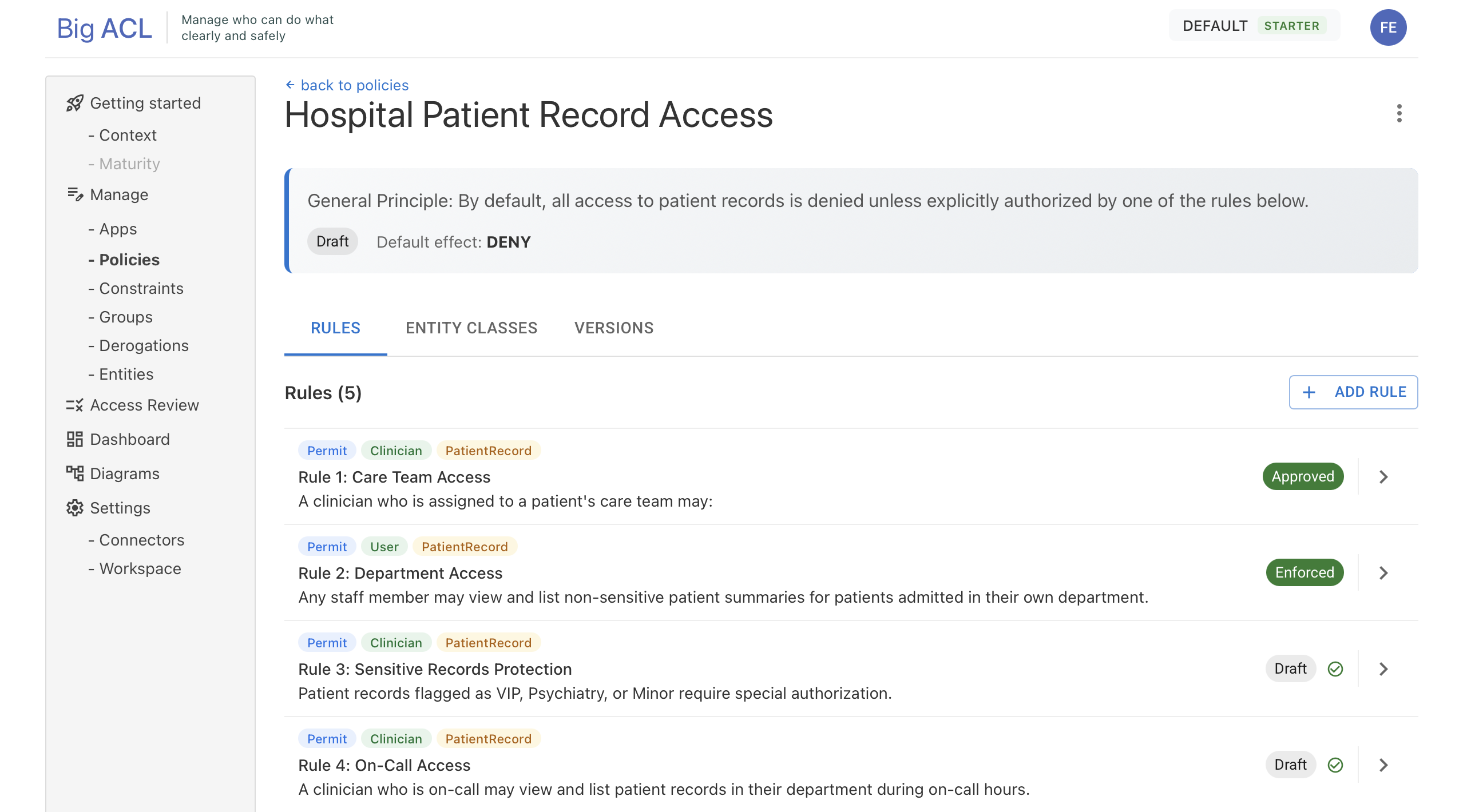 [Screenshot: Big ACL PAP Console showing the policy editor and audit logs]
Concrete Benefits
1. Separation of Concerns
Application code focuses on business logic:
// Before: mixed authorization logic
public Patient getPatient(Long id, User user) {
    // 50 lines of checks...
}

// After: delegation to PDP
@PreAuthorize("@pdp.check('view', #id)")
public Patient getPatient(Long id) {
    return patientRepository.findById(id);
}
2. Modification Without Redeployment
Rules can be updated in real-time via the PAP, without touching code or redeploying the application.
3. Simplified Compliance
- Audit: “Show me all access rules for sensitive data”
- Documentation: policies serve as living documentation
- Certification: tangible evidence for auditors
4. Risk Reduction
- Automated policy testing
- Separate code review for security
- Instant rollback if issues arise
5. Scalability
The same policies can be shared across:
- Web and mobile applications
- APIs and microservices
- Batch and asynchronous processing
Conclusion
Externalizing access control with Big ACL transforms authorization management:
| Aspect | Before | After |
|---|---|---|
| Rule location | Scattered in code | Centralized in PAP |
| Modification | Redeployment required | Real-time |
| Audit | Manual and incomplete | Automatic and comprehensive |
| Testing | Complex | Unit-based and automated |
| Understanding | Reserved for developers | Accessible to business users |
For applications handling sensitive data like medical records, this approach is no longer a luxury but a necessity to ensure security, compliance, and agility.
Additional Resources:
This article was written by the Big ACL team. For any questions, contact us at contact@big-acl.com